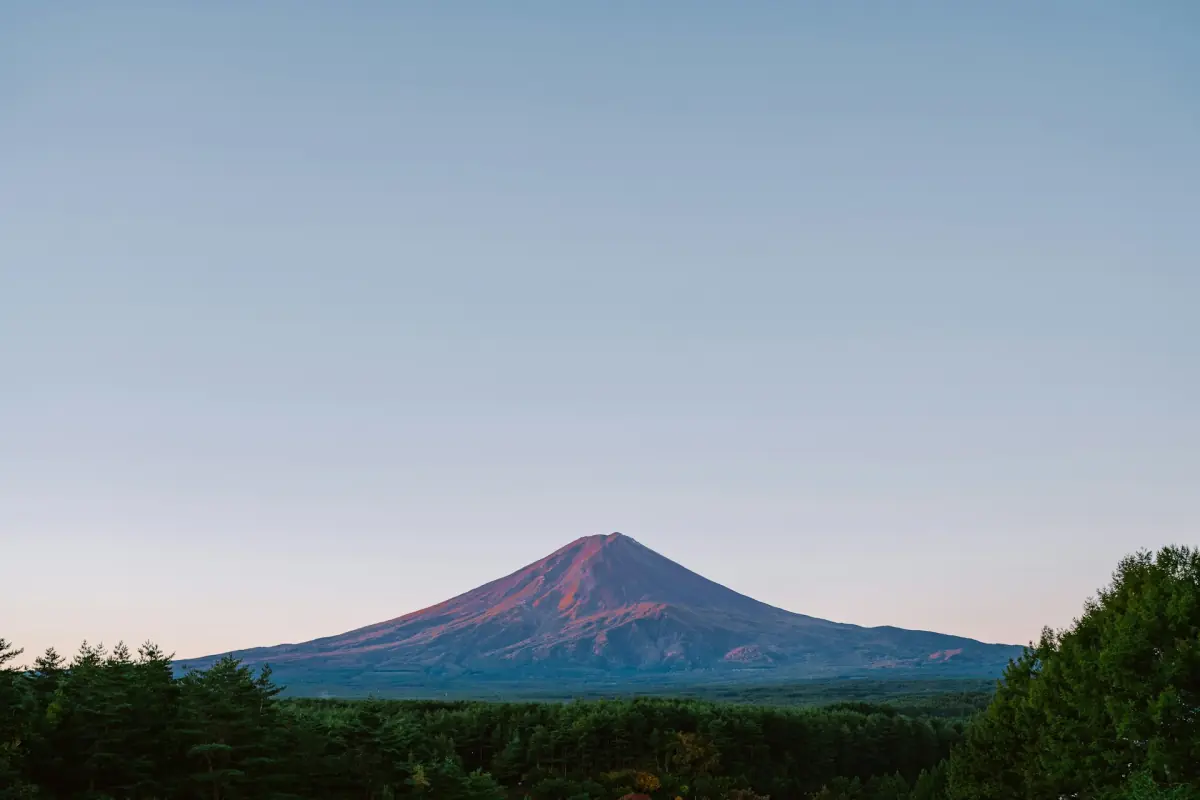
Climbing Mount Fuji only during the authorised season
Climbing Mount Fuji should be planned only during the officially opened season. Avoid summit climbing outside that season: snow, ice, wind and closed huts or rescue facilities change the nature of the mountain. A road visit to a fifth station is a different activity and does not authorise continuing onto closed summit trails.
The completed 2026 Yoshida season ran from 1 July to 10 September. Fujinomiya and Gotemba ran from 10 July to 10 September 2026; Subashiri also ended on 10 September 2026. Plan a later ascent from the newly issued rules, with access dates and fees for that particular season. The seasonal guide separates climbing from a landscape trip.

Four trails and their different demands
The official route overview gives approximate walking values, rather than a timetable that includes every stop. Yoshida has an ascent of 6.8 km taking about six hours and a descent of 7.0 km taking about four hours. Its Subaru Line approach should be identified by name; choose the transport for that access rather than another fifth station.
Fujinomiya starts at 2,400 m. The overview gives 4.3 km and about five hours up, with 4.3 km and about three hours down. The shorter distance does not make it the easiest choice: the route is steep and ascent and descent use the same path. Gotemba starts at 1,440 m, with 10.5 km and about nine hours up, then 8.4 km and about four hours down.
Subashiri starts at 2,000 m. Its ascent is 6.9 km and about seven hours, with 6.2 km and about four hours for descent. Consider the descent as carefully as the ascent when matching a trail to your preparation. Breaks, queues and any crater circuit require their own allowance. For a visit without climbing, see the fifth-station guide.
Our take: Mount Fuji climbing
This two-day climb includes an overnight stay in a mountain hut.
Hand-picked tours, booked through Viator. Prices are indicative starting prices in US dollars (as of November 2026). Tap a tour for live availability and the current price in your currency.

Landscape visits around Fuji
Regional sightseeing options are for mountain scenery and surrounding places; they are separate from a summit ascent.
Yoshida Trail: fees and reservations
For the completed season ending 10 September 2026, Yoshida charged 4,000 JPY per person per passage. Its gate closed from 14:00 until 03:00 the following day, with an exception for overnight hut guests. The daily limit was 4,000 people, again with an exception for hut guests. These exceptions matter when understanding the historical rule; they do not establish a later season's access.
Advance reservation was recommended, with same-day reservation also possible. At the fifth station, officials checked warm clothing, separate waterproof jacket and trousers, and suitable mountain footwear. Access registration and a hut reservation are separate arrangements. A payment for the road or a bus ticket should also be kept distinct from climbing access.
Shizuoka registration and hut planning
Fujinomiya, Gotemba and Subashiri required rule training, registration and proof of entry for the 2026 season ending 10 September. The regular fee was 4,000 JPY per person per ascent. Between 14:00 and 03:00 the following day, a hut reservation was required for night access. The process included showing the entry proof at the fifth station.
Reserve the mountain hut separately and organise the itinerary around its actual operating period. Camping and campfires are prohibited, so a tent is not a substitute for a hut booking. Do not build a plan around year-round hut or rescue availability. Choose the access route first, then organise regional transport and the mountain-road connection for it.
Equipment, altitude and responsible movement
The mountain preparation list includes boots, waterproof jacket and trousers, warm layers, a headlamp and cash or coins. Stay on marked trails, carry out rubbish and leave plants, animals and volcanic stones in place. Before sunrise, congestion below the summit can tempt risky overtaking; keep the ascent within a patient, prepared mountain itinerary.
CDC altitude guidance dated 23 April 2025 explains that fitness does not protect against altitude illness and children can also be affected. Headache, nausea, dizziness and fatigue can be symptoms. Do not sleep higher with symptoms, and descend if they worsen. Discuss relevant existing medical conditions with a clinician experienced in altitude medicine before travelling. The weather guide also shows why lakeside conditions should not be used as summit weather. For an early morning without the climb, there are sunrise trips at the foothills.
Questions about your visit
Can I climb outside the officially opened season?
Avoid a summit attempt outside the authorised season. Plan for the next officially announced opening, rather than using an old tour availability description.
Does entry registration reserve a hut?
Book the hut separately. Mountain access registration, hut accommodation and transport are distinct arrangements.
Which trail is shortest?
The overview lists Fujinomiya at 4.3 km for ascent, but its steep path is shared by ascending and descending walkers. Shorter distance alone does not establish an easier climb.